Oracle's $300B Bet — Why AI Infrastructure Revenues May Be More Solid Than Critics Think
Article originally published on LinkedIn
View original article on LinkedInIn last week's piece we asked: Are we building the next bubble in data infrastructure?
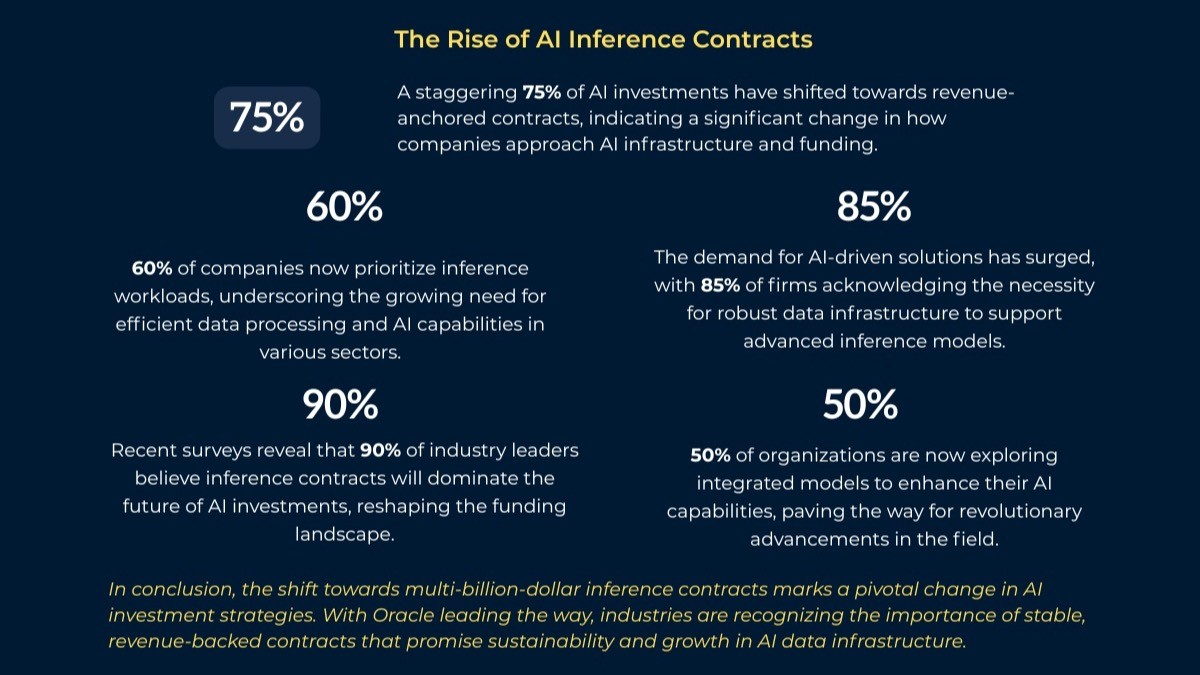
Skeptics argue that massive capital expenditure in AI data centers is outpacing the actual revenues from AI software and services. But there is another side to the story: the rise of multi-billion-dollar inference contracts that are starting to anchor revenue models.
Oracle and OpenAI: A Landmark $300B Deal
In September 2025, reports confirmed that Oracle signed a $300 billion agreement with OpenAI to provide capacity for inference workloads under its Stargate project.
This is not a speculative press release: it is part of Oracle's Remaining Performance Obligations (RPO), which jumped 359% year-on-year to $455 billion in its latest quarterly report.
Larry Ellison has emphasized that inference — running models already trained — will be the long-term growth driver. And OpenAI's contract is not alone. Oracle's Q2 update revealed four new multi-billion contracts signed in just one quarter.
Why Inference Contracts Matter
- Locked-in Demand: Multi-year contracts like the Oracle–OpenAI deal represent legally binding commitments, giving infrastructure providers visibility into future revenues.
- Shift from Training to Usage: Training models requires short bursts of massive compute. Inference, however, is continuous and sticky. As AI applications scale, so does the demand for inference capacity.
- Backlog Precedes Revenue: The spike in Oracle's RPO indicates that future revenues are already secured, even if not yet recognized on the income statement.
- Diversification of Clients: Moody's recently flagged concentration risk around Oracle's largest contracts, but the company has also signed multiple large deals in parallel.
- Integrated Model: Unlike bare-metal providers, Oracle layers software, databases, and cloud services on top of infrastructure, expanding margins and customer stickiness.
Countering the "Bubble" Argument
Yes, risks remain:
- Execution risk in scaling infrastructure.
- Exposure to power costs and regulation.
- Potential renegotiation or cancellation of big contracts.
But these deals show that the AI infrastructure boom is not just speculative CapEx. Revenue models are emerging, anchored by inference contracts worth hundreds of billions.
The bubble narrative paints data centers as empty shells. The Oracle case suggests something different: a new backbone of recurring, contract-based demand that can sustain the industry.
✅ Bottom line: Oracle's $300B inference deal with OpenAI and similar multi-year contracts are transforming AI infrastructure from speculative CapEx into predictable, revenue-backed growth. While risks remain, the emergence of locked-in demand signals a maturing market.
Related Articles

The European Compute Renaissance: Sovereignty, Power, and the $1T AI Infrastructure Race
We are in the midst of the largest infrastructure build-out since the Industrial Revolution. Globally, over $1 trillion is being funneled into digital infrastructure.

Are We Building the Next Bubble in Data Infrastructure?
AI capex is reshaping economies, but is construction running ahead of sustainable revenue? An analysis of the $800B gap between infrastructure investment and revenue generation.

Why Edge Data Centers Are the Missing Link in Europe's Digital Infrastructure
European data center power demand will nearly triple by 2035. Edge data centers offer faster deployment, heat reuse, and strategic flexibility to meet this demand without collapsing grids.