
Valuing Data Centers: How Value Is Created, Locked and Tested Over Time

Article originally published on LinkedIn
View original article on LinkedInIn public markets and analyst notes, data center valuation is often reduced to a single moment: a lease signed, a tenant announced, a capacity milestone reached. Having a strong tenant is what makes the cash flow predictable enough for a bank to provide debt. In the development stages, value in digital infrastructure is created gradually, tested repeatedly, and re-priced at every stage of development. Very similar to what I experienced in renewables: the best ROICs I observed came from flipping projects very early on, when little capital had been invested to secure land, construction permits and grid access. Understanding those stages matters more than headline yields or headline tenants.
But as opposed to renewable energy assets, data centers are not homogeneous real estate. They are long-cycle infrastructure assets whose value emerges in layers. Each layer introduces certainty, but also new forms of exposure. The market tends to reward visibility, yet true resilience is built earlier and tested later.
A useful way to understand valuation is to follow the asset through four main development stages.
Stage 1: Land, Power, and Entitlement — Valuing Optionality
At inception, a data center is not yet a building. It is a set of options: land with zoning compatibility, grid access, environmental permits, and a credible path to power.
Valuation at this stage reflects scarcity rather than cash flow. In constrained markets, land with secured grid capacity often carries more strategic value than an operational facility elsewhere. Investors are not underwriting revenue, but probability.
The key value drivers here are:
- Grid connection rights and voltage level
- Permitting maturity and planning risk
- Physical adjacency to fiber routes and substations
- Expandability beyond the first phase
Market participants often apply €/MW metrics at this stage, with wide dispersion. I've seen ranges between €500k and €1MM at this stage in Southern Europe. A site with provisional grid access may trade at a fraction of one with firm capacity allocation. The difference is not technical, it is regulatory and temporal.
Time-to-market dominates valuation logic. In mature European hubs, shaving two years off permitting timelines often creates more value than marginal CapEx efficiency. Capital prices speed before it prices perfection.
At this stage, valuation is about optionality. The buyer is paying for the right to build under conditions that others cannot easily replicate.
Stage 2: Construction and Shell Completion — Valuing De-risking
Once construction begins, the asset transitions from optionality to execution. Capital deployed becomes visible. Timelines harden. Risks shift from regulatory to operational.
Valuation increases as uncertainty compresses. Completion of civil works, substations, and base MEP infrastructure allows investors to apply replacement-cost logic alongside development margins.
At this stage, buyers focus on:
- Delivery certainty versus budget
- Standardization of design
- Power density assumptions embedded in the shell
- Upgrade paths for cooling and electrical topology
This is where many valuation disagreements emerge. A shell designed for 15–20 kW per rack carries a different long-term profile than one engineered for 60 kW+, even if both are "AI-ready" on paper.
Construction-stage assets often trade on a blended basis:
- capital deployed to date
- remaining CapEx to completion
- risk-adjusted development premium
Here, valuation reflects confidence in execution rather than income. The market rewards teams that demonstrate repeatability, supply chain control, and delivery discipline.
Stage 3: Lease-Up and Stabilization — Valuing Visibility
The moment a hyperscaler or anchor tenant signs a lease, valuation language changes. Yield replaces €/MW. Cash flow replaces optionality. The asset begins to resemble infrastructure.
This is the stage most visible to public markets. Announced leases often trigger re-ratings, equity rallies, and compressed cap rates. Long-term contracts create predictability, which lowers the cost of capital.
At stabilization, valuation is driven by:
- Contract duration and escalation profile
- Tenant credit and concentration
- Operating efficiency and PUE performance
- Financing structure and interest rate exposure
Historically, the market treated hyperscaler contracts as utility-like. Long leases, strong counterparties, and assumed renewal created an annuity mindset.
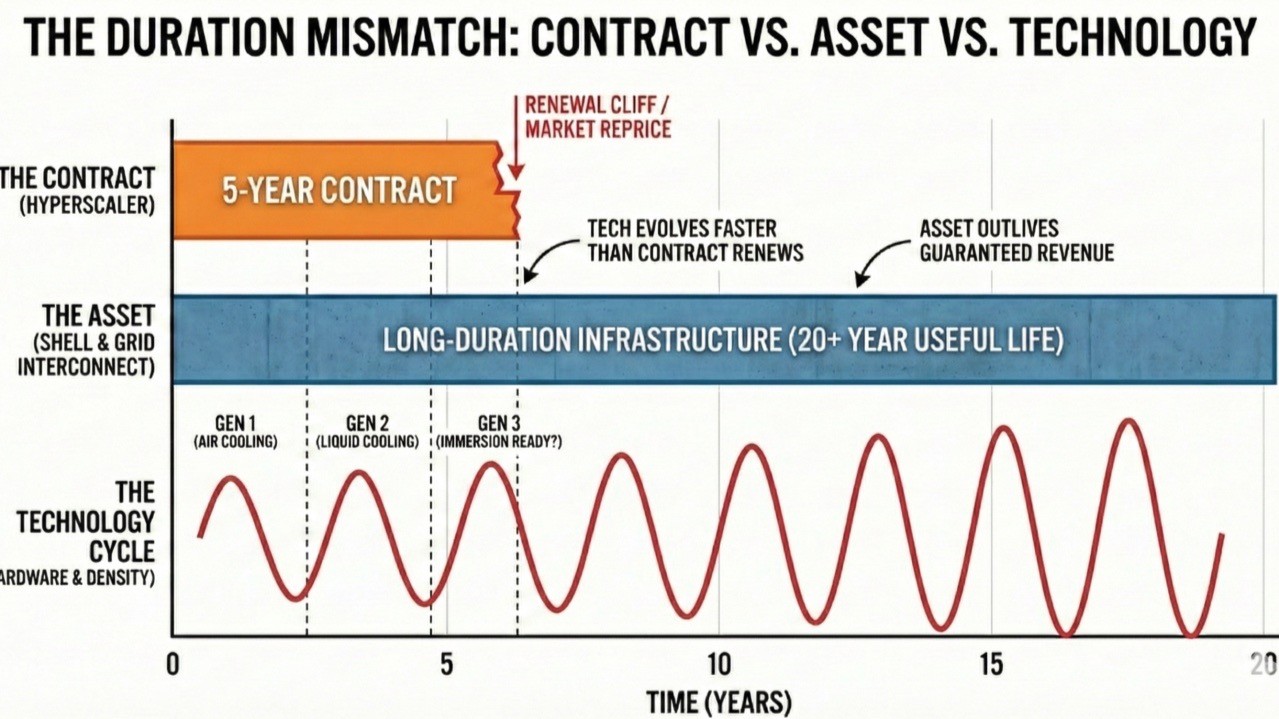
What sophisticated investors now examine more closely is the alignment between contract life and asset life. A five- to seven-year lease on infrastructure designed for thirty years introduces a re-pricing point. Investors increasingly model multiple outcomes at lease expiry rather than a single renewal assumption.
At this stage, valuation rewards visibility, but durability is priced through assumptions rather than guarantees.
Stage 4: Relevance, Renewal, and Reinvention — Valuing Adaptability
The final stage is where valuation becomes most selective. As hardware cycles shorten and densities evolve, facilities are tested against new operating requirements.
Here, the asset's value depends less on its original design and more on its capacity to remain relevant.
Key drivers include:
- Cooling topology adaptability (air, liquid, hybrid)
- Electrical headroom and voltage architecture
- Physical constraints on rack spacing and fabric length
- Retrofit CapEx required to host next-generation platforms
In this phase, investors evaluate the "cost of relevance." That includes:
- planned retrofit CapEx per kW
- downtime exposure during upgrades
- alternative uses for encumbered power
- liquidation or repurposing value
This is where infrastructure thinking replaces real estate thinking. The shell alone does not carry value. The embedded systems do. Valuation becomes scenario-based rather than static. Assets capable of absorbing new workloads without structural rework command a premium. Those requiring extensive retrofit trade on a different curve.
Long-term value accrues to assets designed with adaptability as a core principle rather than an afterthought. Modular design here has an advantage: demonstrate that the MWs can turn into revenue without a retrofit that becomes obsolete before it pays back.
What the Market Is Learning
Across these four stages, one theme is consistent: valuation is not a single event. It is a sequence of confidence transfers.
Early value comes from access. Mid-stage value comes from execution. Stabilized value comes from visibility. Long-term value comes from adaptability.
The most resilient investors align capital structure, lease strategy, and technical design across all four stages. They price renewal risk explicitly rather than implicitly. They underwrite relevance rather than assume it.
As AI accelerates infrastructure demand, the assets that perform best will not be those whose value survives the moment contracts roll and platforms change.
Closing Thought
Data centers reward patience, precision, and technical fluency. Their valuation reflects not only what has been built, but what can still be built inside the same footprint.
In digital infrastructure, value is not created once. It is earned repeatedly.
And the assets that endure are the ones designed to pass every stage, not just the first. In my view, modular design is what makes the asset resilient to the chip race.
Related Articles
The Trillion-Dollar Illusion: Why Data Centers Aren't the Next Renewables
The AI revolution has inverted the asset class. We are no longer building real estate; we are building rapidly depreciating industrial machinery inside a concrete box.

Are We Building the Next Bubble in Data Infrastructure?
AI capex is reshaping economies, but is construction running ahead of sustainable revenue? An analysis of the $800B gap between infrastructure investment and revenue generation.

What is a Data Center? The Five Pillars of Europe's Digital Future
Data centers are the backbone of the digital economy — the factories of the 21st century — representing a market worth over $1 trillion globally.