
The Trillion-Dollar Illusion: Why Data Centers Aren't the Next Renewables
Article originally published on LinkedIn
View original article on LinkedInFor the better part of a decade, the investment thesis for data centers was simple, elegant, and, in hindsight, dangerously comfortable. It was the same playbook used by the early pioneers of renewable energy: chase stable cash flows, lock in long-term contracts with creditworthy counterparties, and finance the whole thing like a utility.
I started my infrastructure career erecting solar farms with locked-in feed-in tariffs. Just as early solar investors relied on secured feed-in tariffs and predictable 25-year asset lifespans, data center investors looked at a lease from a hyperscaler like Google or Microsoft as a high-yield annuity. The technology risk in solar was manageable: over 25 years, panels grew from 150 Watts to 600 Watts, representing marginal efficiency gains while the fundamental physics remained the same. It is only now, after 20+ operating years, that the solar panels we installed are being replaced, whilst the single-line electric schema of the park remains mostly unchanged.
But as we hurtle toward 2030, that mental model is a trap. The AI revolution has inverted the asset class. We are no longer building real estate; we are building rapidly depreciating industrial machinery inside a concrete box. If you are underwriting a data center today with the same conservative lens used for a wind farm, you're gambling on the tech evolution.
The Mismatch: 3-Year Hardware vs. 30-Year Infrastructure
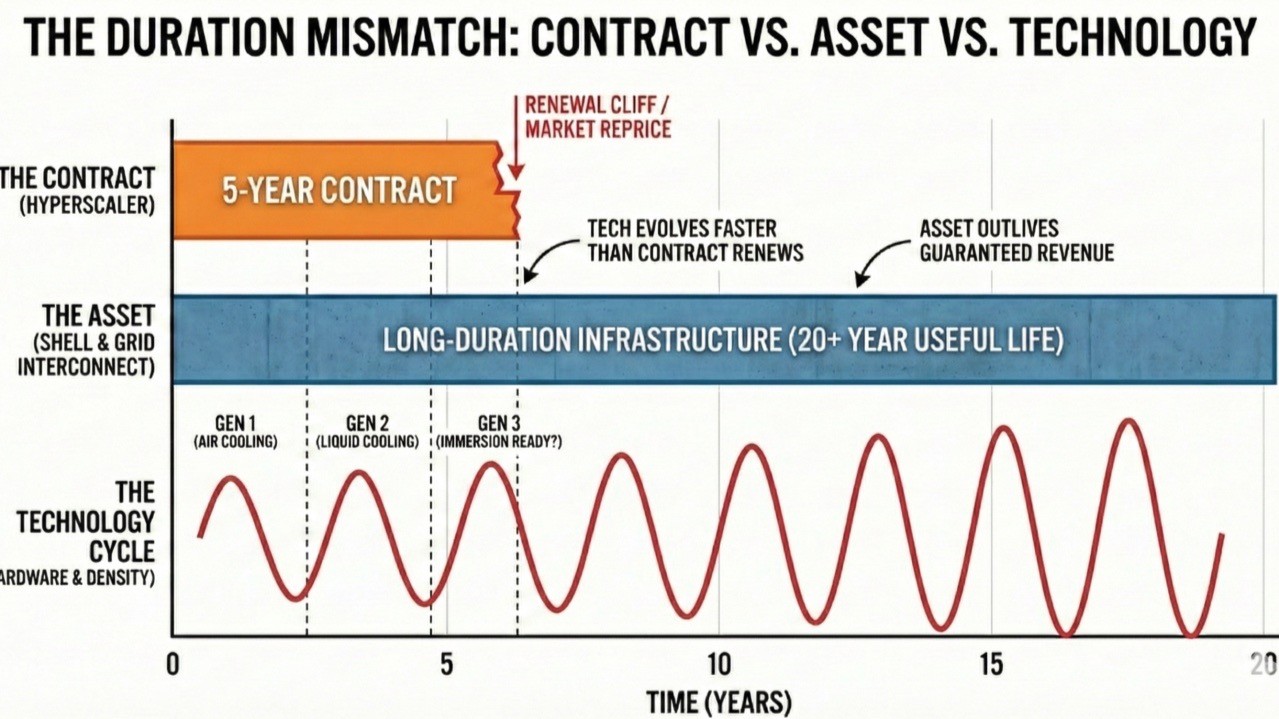
The core of the crisis lies in a fundamental temporal mismatch. A massive 1-GW data center campus is, by definition, heavy, long-cycle infrastructure. Its civil works, interconnects, and structural shells are designed for a thirty-year horizon.
However, the revenue stream is now tied to hardware cycles that render themselves obsolete every three years. In the renewable world, a solar farm built in 2010 still produces 70% of the original electricity profitably today using the same basic topology. In the data center world, a facility designed for the Blackwell generation of GPUs may be physically incapable of supporting the Vera Rubin generation just three years later.
Density assumptions are changing faster than mechanical and electrical systems (MEP) can be rebuilt. We are seeing the death of the one-size-fits-all lease. Customers are leasing capability. Specifically, the ability to run the most advanced chipsets at every moment in time and at extreme temperatures.
The Three Walls of Obsolescence
As the Why Data Defense Matters newsletter has long argued, digital infrastructure is the new frontline of sovereignty. But if that infrastructure becomes unfit for purpose in five years, the sovereign shield crumbles. According to recent insights, three technical walls are making current buildings obsolete:
1. The Thermal Wall Facilities designed for air cooling, the standard for decades, cannot support the direct-to-chip liquid cooling (DLC) required for high-density AI pods without a massive, nine-figure retrofit. Racks are jumping from 10kW to 100kW, and specialized AI pods are already targeting 500kW.
2. The Power Architecture Wall We are hitting the physical limits of amperage on standard copper cabling. The shift from 480V AC to 800V DC is a fundamental topology break that requires stripping a building to its studs and rebuilding it from scratch.
3. The Fabric Topology Wall New AI architectures have hard distance limits for copper cabling (often as short as 3 meters). A legacy facility designed with long hot/cold aisles simply cannot support the physical layout required by the next generation of compute.
The Encumbered Power Trap
Bulls in the market often point to power scarcity as the ultimate moat. The logic is: "Even if the tenant leaves, I still own the grid connection."
This ignores the cost of access. If a site requires a nine-figure renovation to be usable for next-gen densities, that megawatt is encumbered power. In five years, an old AI building will be competing against modular, greenfield sites designed from the ground up for liquid cooling and optical interconnects.
At BtMData, we are seeing this reality play out in real-time. Investors who prioritize Speed over Cost are accepting 25% price uplifts just to get into the game. But speed without technical future-proofing is just a faster way to reach obsolescence. For this reason, we have developed the DC Configurator, with modularity designed as per functionality. Each module contains a functionality (cooling, power, servers, connectivity), to make it easier future replacements and upgrades.
A New Diligence Standard: The Year-X Survival Model
The specialized investor of 2026 must move beyond the spreadsheet. Traditional infrastructure funds are comfortable with credit risk; they are uncomfortable with topology risk.
To survive the trillion-dollar bet, boards must demand a Year-X Survival Model. This underwriting approach must:
- Explicitly carry €150–200 per kW in retrofit capex to maintain fitness for the next hardware refresh.
- Price the Kill Cost: the expense required to strip the interior MEP to unlock the underlying power value.
- Account for the 12-to-18-month Dark Period where the facility generates zero revenue during reconstruction.
If the deal breaks under these scenarios, you aren't underwriting an asset; you are underwriting a wish.
The Verdict: Specialized Capital is the Only Capital
The era of the "Generalist Infrastructure Fund" in data centers is ending. The risks are no longer just about interest rates or tenant credit; they are about Silicon Photonics, Direct Liquid Cooling and Dynamic Line Ratings.
Data centers are the most critical infrastructure of our time, essential for digital sovereignty and the global race for AI supremacy. However, unlike the stable, predictable world of early renewables, the data center economy is a high-velocity tech bet.
The question for any committee evaluating a gigawatt-scale project is simple: What is this asset worth the day the contract expires if the renewal doesn't happen? If your answer is "they'll renew because there's a power shortage," you don't have a thesis. You have a gamble.
In the world of Data Defense, the only thing more dangerous than no infrastructure is obsolete infrastructure. Investors must wake up to the fact that they are leasing capability, not space. The buildings might last thirty years, but the brains inside them have the shelf life of a smartphone. Price your capital accordingly.
Related Articles
Valuing Data Centers: How Value Is Created, Locked and Tested Over Time
In public markets, data center valuation is often reduced to a single moment. But value in digital infrastructure is created gradually, tested repeatedly, and re-priced at every stage of development.

10 Things Your Competitors Will Look at with Envy in 12 Months: 2026 Data Center Trends
The global race for AI has entered its most physical phase. As we move into 2026, the industry is shifting from software algorithms to a brutal competition for power, land, labor, and raw materials.
Are We Building the Next Bubble in Data Infrastructure?
AI capex is reshaping economies, but is construction running ahead of sustainable revenue? An analysis of the $800B gap between infrastructure investment and revenue generation.