10 Things Your Competitors Will Look at with Envy in 12 Months: 2026 Data Center Trends

Article originally published on LinkedIn
View original article on LinkedInThe global race for artificial intelligence has officially entered its most physical phase. As we move into 2026, the industry is shifting from a focus on software algorithms to a brutal competition for the physical resources that make them possible: power, land, labor, and raw materials. In this context, infrastructure is no longer a backend concern; it is the frontline of national security and digital sovereignty.
Drawing on the latest findings from the "Data Centre Trends Report 2026" and the technical frameworks we use at BtMData, here are my 10 predictions for the data center sector in 2026.
1. The Copper Squeeze: Why Raw Materials are the New Gold
The massive expansion of the power grid to support AI demand is driving a surge in the price of essential raw materials. While much of the talk in late 2025 centered on rare earth elements becoming rarer due to trade restrictions, the real bottleneck for grid expansion is copper. With global data center infrastructure spending projected to exceed $1.7 trillion by 2030, the demand for copper in cabling, transformers, and power distribution units is unprecedented. I am comfortable investing in copper as a core commodity for the AI era. It is the lifeblood of the physical grid, and as Gulf state investors have already realized, securing a supply of critical minerals is now a strategic necessity for anyone building digital infrastructure.
2. Speed Becomes the Only Metric that Matters
In 2026, the industry mantra is: Speed equals revenue. Whoever can bring capacity online fastest wins the market share. Traditional construction timelines of 3 to 7 years are no longer acceptable in a world where AI infrastructure doubles every year. Developers are now "shifting left," accepting higher construction costs, sometimes as much as a 25% uplift in tender prices, just to compress delivery schedules. At BtMData, we are seeing clients prioritize time-to-power over capital expenditure, as the opportunity cost of an idle data center far outweighs the premium of an accelerated build.
3. The Rise of Inference and the Surge in Edge Data Centers
While 2024 and 2025 were about training massive AI models in remote locations, 2026 is the year of AI Inference. Once models are trained, they need to run close to users to ensure low latency. This is triggering a "search for sites" acceleration in urban hubs. We expect the edge computing market to grow by over 30% annually, as 5G rollouts and IoT connections, set to reach 60 billion by 2034, require data centers to be located close to industrial and residential centers.
4. Industrialization: Modular Builds Become the Standard
To meet these ambitious timelines, we are moving away from bespoke, "stick-build" construction toward an industrialization revolution. By 2026, the use of prefabricated elements and modular construction will be the norm for hyperscalers and colocation providers alike. This is where the BtMData technical philosophy shines: using standardized modules for mechanical, electrical, and plumbing (MEP) systems to reduce construction schedules by up to 20%.
5. Gas is Back as the Grid's Bridging Solution
The inability of traditional electricity grids to cope with the AI load has brought natural gas back into fashion. While the industry remains committed to 100% renewable energy by 2030, natural gas generators are serving as a vital "bridging solution" during the 5-to-10-year wait for grid upgrades. Major players like Oracle are already signing deals for gigawatts of natural gas capacity to ensure their AI data centers are powered today, not a decade from now.
6. Liquid Cooling Breaks Through the Heat Barrier
The power density of AI racks is skyrocketing, with some specialized pods exceeding 500 kW per rack. Traditional air-based cooling can no longer keep up. In 2026, liquid cooling initiatives will be in place in over 80% of new colocation data centers. We expect Direct Liquid Cooling (DLC) to dominate the near term, while immersion cooling—submerging entire servers in dielectric fluid—will begin its transition from a niche solution to a commercial standard for high-performance computing (HPC).
7. Flexible Grids and the Conditional Firm Contract
The most innovative regulatory shift of 2026 is the adoption of flexible grid connections, or "Conditional Firm" service. Rather than waiting years for a traditional firm connection, BtMData is recommending that clients "connect now and operate flexibly". Under this model, data centers rely on grid power >99% of the year but switch to on-site resources (like batteries or gas) during brief periods of grid stress. This technical proposal allows data centers to reach full operation 3 to 5 years faster than traditional processes.
8. Silicon Photonics Unlocks the Next Scale of AI
Silicon photonics will begin to break the main bottlenecks in data centers by replacing copper with optical links within the facility. This enables higher bandwidth and lower power consumption for the massive interconnection of compute and memory required by thousands of GPUs. While we need raw copper for the external power grid, internal data center networking is moving toward light-speed connectivity.
9. The Tide Turns for Trade Careers: The Blue-Collar Boom
A surprising trend for 2026 is the narrative shift around skilled trades. As Nvidia's Jensen Huang predicted, "electricians and plumbers will triumph in the AI race". Data center infrastructure projects are doubling every year, creating a massive shortage of skilled craftworkers. We are seeing a surge in Gen Z interest in technical vocational training, lured by six-figure salaries and the realization that you cannot build the cloud without boots on the ground.
10. The Year of Commercial Quantum-Ready Infrastructure
Finally, 2026 is the year we get Quantum Ready. While still in the early stages, commercial quantum data centers are launching in hubs like New York, London, and Barcelona. These facilities require specialized environments—vibration-shielded "quantum pods" cooled by liquid helium. While full commercial viability is a decade away, hyperscalers are already integrating quantum racks into their AI environments to handle complex future workloads.
Conclusion: Shifting Up a Gear
2026 will be the year of the "Megawatt Duel." The strength of a nation's digital economy will be measured by its ability to deploy power at the speed of software. At BtMData, we believe that navigating this complex landscape requires more than just capital; it requires seniority, technical innovation, and a willingness to embrace flexible energy models.
The era of "business as usual" is over. It's time to shift up a gear.
Related Articles
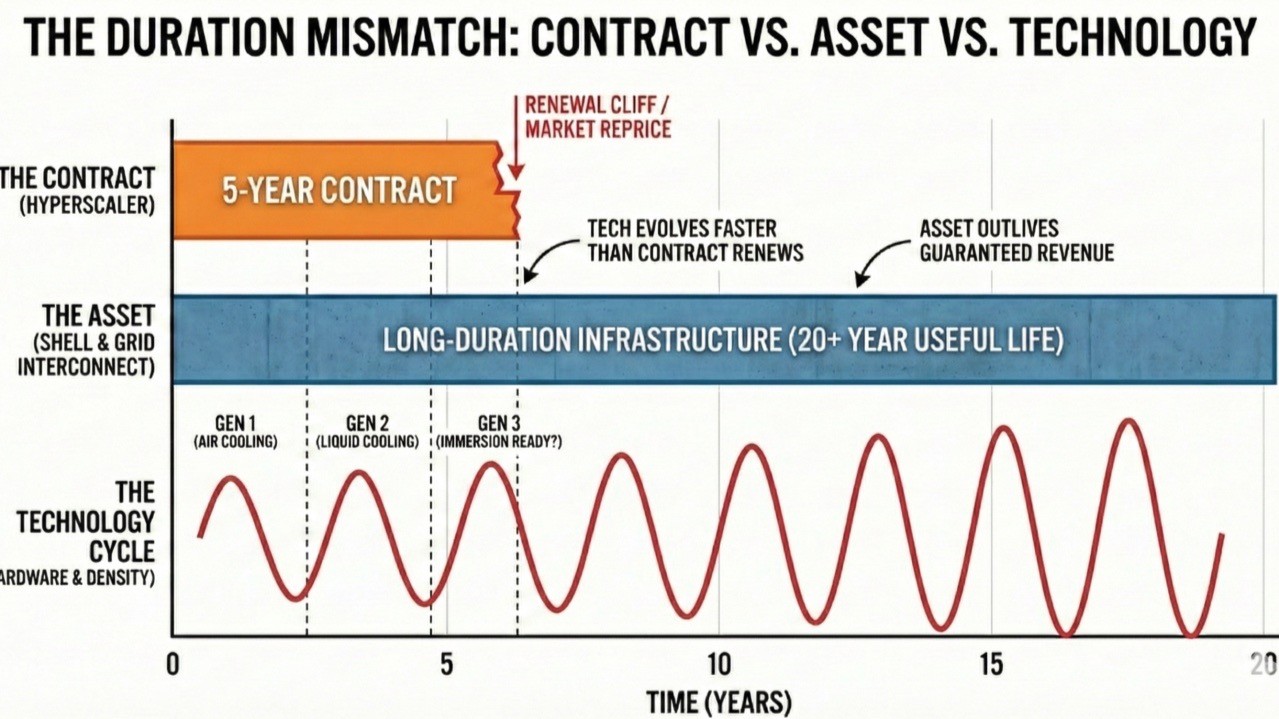
The Trillion-Dollar Illusion: Why Data Centers Aren't the Next Renewables
The AI revolution has inverted the asset class. We are no longer building real estate; we are building rapidly depreciating industrial machinery inside a concrete box.
Are We Building the Next Bubble in Data Infrastructure?
AI capex is reshaping economies, but is construction running ahead of sustainable revenue? An analysis of the $800B gap between infrastructure investment and revenue generation.
Why Edge Data Centers Are the Missing Link in Europe's Digital Infrastructure
European data center power demand will nearly triple by 2035. Edge data centers offer faster deployment, heat reuse, and strategic flexibility to meet this demand without collapsing grids.