
Why Data Sovereignty Matters: Europe's Data Centre Market Is Growing Beyond FLAP-D
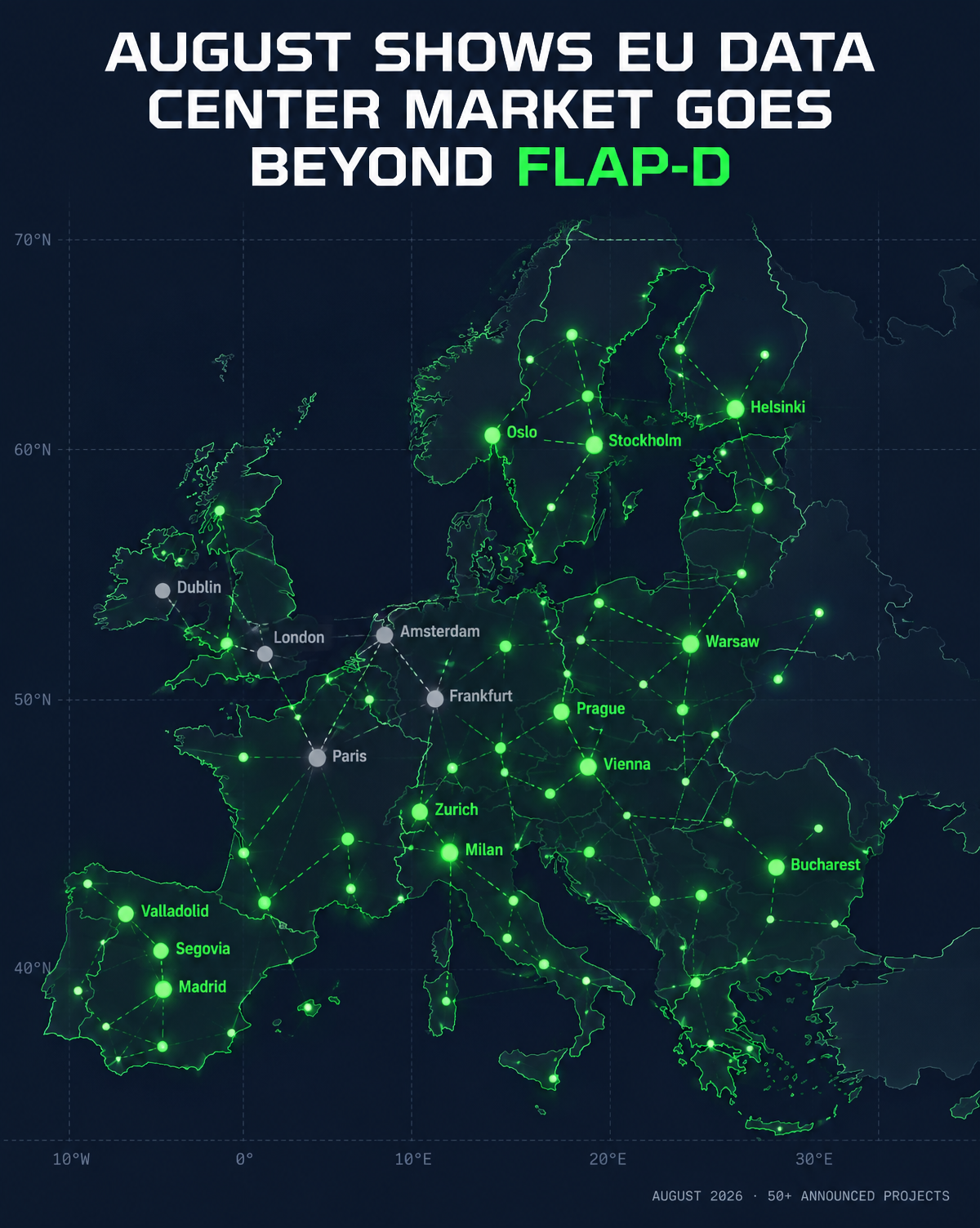
For more than a decade, the European data centre market could be summarised in five letters: FLAP-D. Frankfurt, London, Amsterdam, Paris and Dublin concentrated the fibre, the cloud regions, the interconnection ecosystems and most of the capital. Everything else was "secondary".
August 2026 suggests that framing is now outdated. In a single month, more than forty projects were announced, expanded or advanced across Europe. Most of them were not in FLAP-D. And a striking share of them were not greenfield campuses, but conversions of existing industrial, energy and telecom assets.
The thesis of this article is simple: Europe's data centre growth is moving to where deliverable power can be assembled, and brownfield transformation is becoming one of the fastest routes to get there. That shift also matters for sovereignty, because it determines where Europe's compute physically sits and who controls the energy behind it.
The geography is being redrawn by power
The core FLAP-D markets are not disappearing. But they are constrained. Grid connection queues in Amsterdam, Dublin, Frankfurt and West London are measured in years, land is expensive, and political tolerance for new large loads is shrinking. When power becomes the binding constraint, capacity goes where power is.
August made that visible across four regions.
The Nordics and Baltics. EcoDataCenter is advancing a 150 MW campus in Dalarna, Sweden. atNorth's Kouvola campus in Finland can reach up to 430 MW, and Helios Nordic has proposed up to 500 MW in Lapinlahti. Nebius announced 70 MW in Mäntsälä and a 22 MW deployment in Tallinn. Smaller modular plays — Magnora and Blix in Oslo, Fossefall and Armada in Norway, Velox with FuriosaAI in Stockholm — show that the region is not only about mega-campuses.
Iberia. Spain had one of its densest months: Global Switch broke ground on a second Madrid facility of 56 MW, Nabiax plans to scale Madrid from 35 to 140 MW of IT load, DC Mudarra targets 160 MW of IT load near Valladolid, Digital Valley Asturias reported 120 MW, and IGNIS with Acciona is pairing a Segovia data centre with solar generation. Iberia combines renewable abundance with relatively competitive industrial power prices, and Spain's new grid-access rules will reward projects that can prove deliverable power.
Central and Eastern Europe. In Warsaw, Sien Real, Budimex and Ferrovial are moving forward. In Romania, WDP secured 380 MW of approved grid connection at Ștefăneștii de Jos — a connection figure, not a disclosed IT load. In Prague, CRA and Skanska are developing the 26 MW Prague Gateway.
The Alps, Italy and southern France. Digital Realty started 15 MW of IT capacity in Glattbrugg, near Zurich. NexSpace is expanding in Graz and GARBE.DC is studying Leopoldsdorf, Austria. In Italy, Cobra Green Hyperscale and Tendercapital announced 150 MW in Colleferro, and Comtel with Ge-Group is integrating a Florence facility with an 84 MW solar plant.
Even within Germany and the UK, growth is spreading outward: Schwarz Digits in Dummerstorf (240 MW, with potential up to 1 GW), maincubes in Schwalbach, DataVita in North Lanarkshire, TBC Partners in Cambois (up to 300 MW) and Latos in Manchester.
Brownfield is becoming a delivery strategy
The second pattern is less discussed but just as important. Many of August's projects reuse something that already exists.
- AZUR and Arago are converting a former industrial hydrogen facility in Champagnier, France, into a high-density data centre.
- T1 Energy is turning an existing industrial facility in Mo i Rana, Norway, into a 50 MW site.
- FiberCop is transforming more than 100 Italian telecom exchanges into edge data centres of up to 1 MW each.
- In London, the Truman Brewery is being repurposed for 5.2 MW of capacity.
Brownfield conversion is not a niche aesthetic choice. It is an answer to the three hardest problems in data centre development: power, permits and time. A former factory, smelter, thermal plant or telecom exchange often comes with an existing grid connection or substation, industrial zoning, heavy-duty structures, water rights and a community that is used to industrial activity. Each of those can remove months — sometimes years — from the critical path.
Europe has thousands of such assets. Deindustrialisation, energy transition and the consolidation of telecom networks are releasing powered land at exactly the moment AI demand needs it. The question is no longer whether these sites exist, but whether they can be converted into bankable projects.
Megawatts are not all the same
A consolidated view of August also exposes a reporting problem. Announcements mix IT load, facility electrical load, approved grid connection and on-site generation capacity as if they were interchangeable. They are not.
Kennedy Wilson's West London project is a good example: 48 MW of IT load corresponds to roughly 64 MW of electrical demand. WDP's 380 MW is a grid connection, not a data hall. Comtel's 84 MW is solar generation, not compute. Adding these numbers together produces an impressive but misleading headline.
For investors, tenants and regulators, that distinction is fundamental. A grid connection is an option, not a running data centre. Bankability depends on evidence: what power is firm, in which hours, under which contracts, and with what route to ready-for-service.
Capital follows contracted demand
The third signal is financial. Institutional capital is increasingly tied to identified tenants. DataVita's £300m investment in Lanarkshire came alongside a confirmed demand story, and neocloud operators are now signing multi-year capacity contracts before sites are built. In this market, the scarce asset is not the announcement — it is the combination of a credible site, deliverable power and a signed tenant.
Why this matters for sovereignty
Data sovereignty is often discussed in terms of legal jurisdiction and cloud contracts. But sovereignty also has a physical layer. If Europe's AI capacity can only be built in five congested metros, its digital autonomy depends on a handful of grid nodes and a few dominant players.
A more distributed map — Nordic hydro, Iberian solar, Central European industrial grids, Alpine free cooling — makes the system more resilient. Converting European industrial assets also keeps value, jobs and energy infrastructure anchored in the territories that built them. Brownfield transformation is, in that sense, an industrial policy as much as a real estate strategy.
The real scarcity is execution
Europe is not short of proposed megawatts. It is short of projects that can prove deliverable power, secure permits, align with energy regulation and reach RFS on schedule.
That is the gap BtMData addresses: transforming industrial and energy assets into viable data centre projects. [GridPass](/gridpass) provides the evidence layer — power, hourly renewable matching, compliance and bankability on measured data. [Smart Power Cap](/gridpass) aligns compute demand with real electrical constraints, so dense AI clusters can operate within the grid connections that actually exist. Our live map of more than 3,300 European data centres shows where that capacity already sits.
FLAP-D will remain important. But the next chapter of European digital infrastructure is being written elsewhere — in old factories, power plants and telecom buildings that are about to become something new.
✅ Bottom line: Europe's data centre market is growing beyond FLAP-D, and brownfield transformation is one of its fastest routes to market. The winners will be those who can turn powered land into verified, bankable capacity.
Related Articles
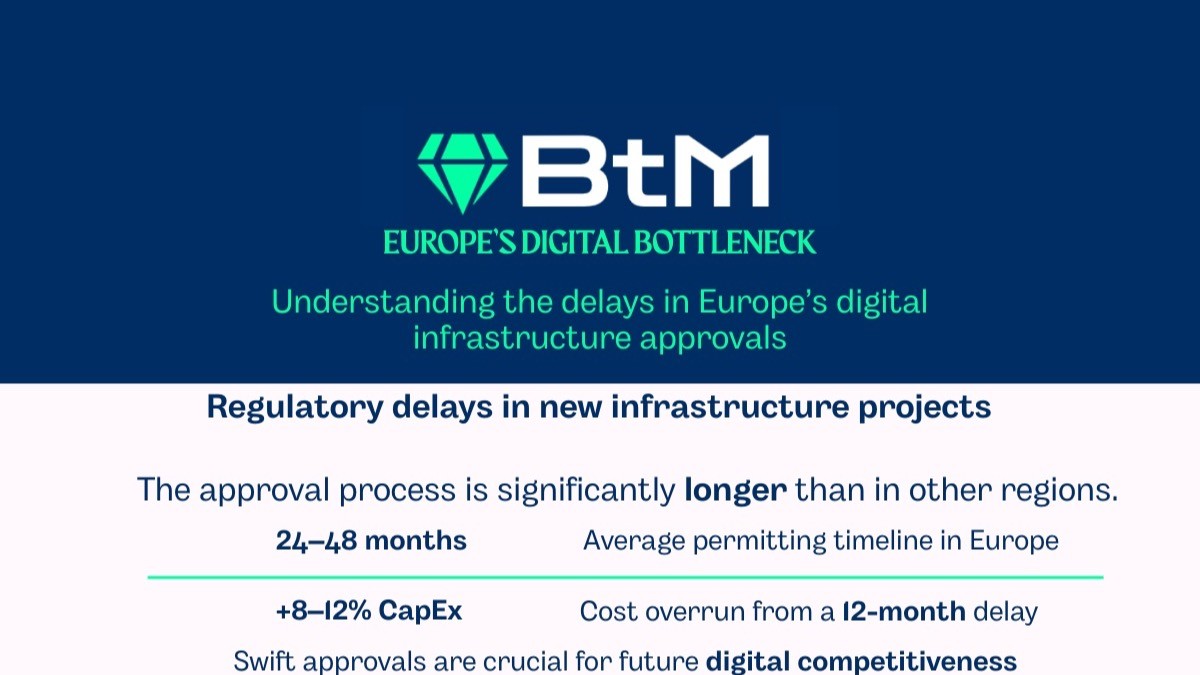
Europe's Regulatory Bottleneck: When Permits Become a Strategic Risk for Data Centers
Excessive regulation, slow permitting, and fragmented administrative processes have become a systemic constraint across almost every industrial sector in Europe.

From Marshall Plan to Data Plan: Spain's Energy Advantage
Spain transforms from being excluded from the Marshall Plan to becoming Europe's data center hub, powered by cheap renewable electricity and massive infrastructure investment.

Why Edge Data Centers Are the Missing Link in Europe's Digital Infrastructure
European data center power demand will nearly triple by 2035. Edge data centers offer faster deployment, heat reuse, and strategic flexibility to meet this demand without collapsing grids.